A Thought Being Thought
This began as a meditation on the block universe existing in the mind of God. It became something more personal: a reflection on suffering, and on an intimacy possible only with the one who can enter our most painful moments and remain there with us.
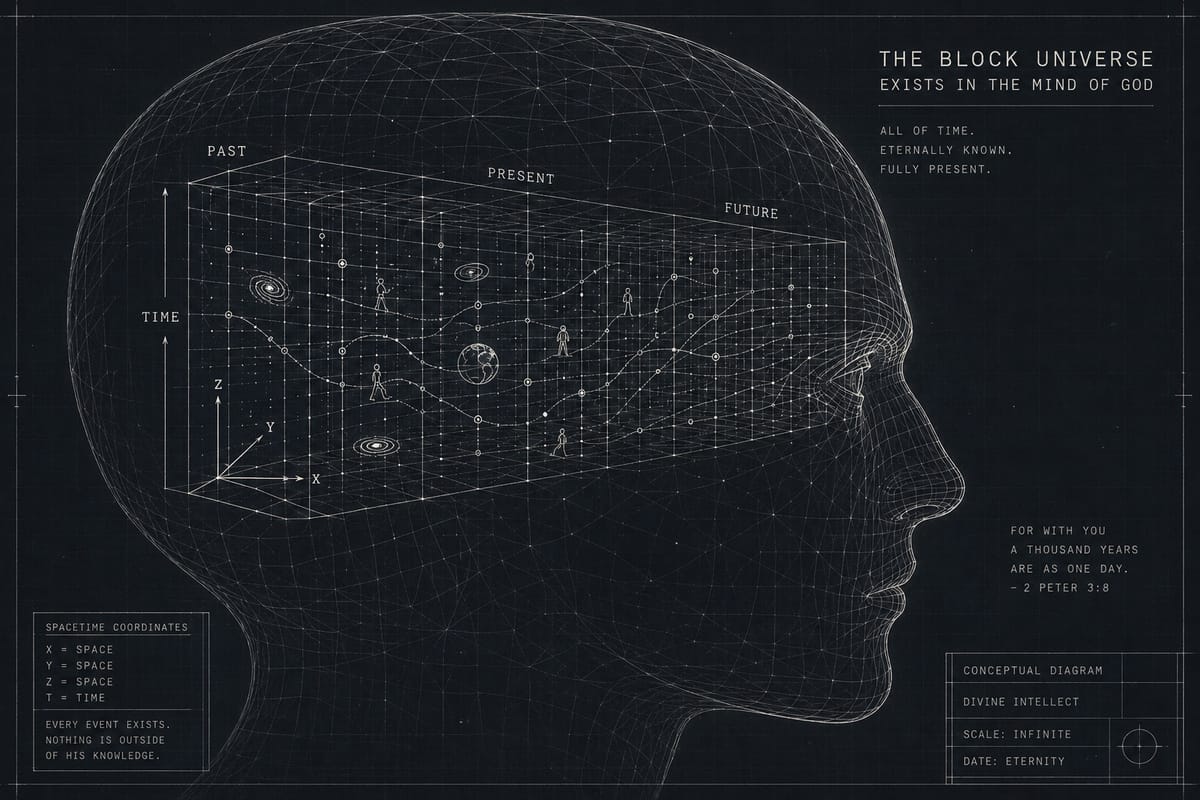
Start with something simple.
Every life traces a path through space and time. You are here, and then you are somewhere else. A moment passes, then another. If your life could be charted from birth to death, it would look less like a point and more like a thread running through the world.
Physicists call this path a worldline.
Some physicists and philosophers take the theory of relativity to suggest that the entire line exists in some sense: past, present, and future gathered into a single structure rather than coming into existence one frame at a time. They call this the block universe.
I do not know whether that interpretation is ultimately right. But the image stayed with me.
The Bible also speaks strangely about God and time. It says he knit us together in the womb. It says our days were known before one of them came to be. Jesus says, “Before Abraham was, I am,” speaking in the present tense from somewhere that does not seem confined to the clock.
Scripture often talks as though God is not being carried along by time the way we are. He does not merely remember the past and anticipate the future. He sees the whole.
So I began to wonder whether these two pictures might illuminate each other.
And there was a third thing that pushed me toward tying them together.
Down at the smallest scale, physics ran into something genuinely unsettling: what we can observe cannot be separated neatly from how we choose to observe it. A particle can reveal one kind of behavior under one arrangement and another kind under another. Measurement is not merely a window through which we look at an already finished reality. Somehow, it belongs to the event.
Physicists can describe these results with extraordinary precision. What they cannot agree on is what, underneath the mathematics, finally makes one possibility become the reality we experience. Is the measurement completed by the detector? By its interaction with the surrounding world? By the information becoming irreversible? By its arrival in awareness? Or is the whole chain—from possibility to measurement to observer—one completed event that cannot truly be divided?
No experiment allows us to stand outside that chain and watch reality settle itself when no observation will ever occur.
Which raises a quiet, enormous question: if being observed is somehow bound up with what becomes real, what is holding everything together when no human eye is on it at all?
What is the observation that never looks away?
That question led me toward a much older idea.
Bishop Berkeley argued that existence is inseparable from perception and that the world remains real because it is always perceived by God. Jonathan Edwards also imagined the material world as radically dependent upon the divine mind.
Aquinas approached the same mystery differently. He did not say that the world is merely an idea, but he did insist that creation does not possess existence independently. God does not wind the universe up and step away. Everything that exists receives its existence from him continually.
If God ceased to sustain a thing, it would not slowly decay. It would simply no longer be.
Existence is not something we own.
It is something being given to us at every moment.
Put these ideas together, and a picture begins to form.
Perhaps your whole life exists before God as a single, complete reality. But it does not sit in empty space, cold and unattended. It is held in a mind.
God is not watching your life arrive one moment at a time. He holds the whole of it in one act of attention.
What we experience as the flow of time may be what it feels like to live through that reality from the inside.
Time is the shape our existence takes as we move through it.
God’s attention is what keeps the whole thing from falling into nothing.
We are thoughts being thought.
And the thinking of us is what we experience as a life.
Then the hard part appeared, the way it always does.
If every moment of a life remains fully present to God, then so does every moment of pain.
The worst thing that ever happened to you is not hidden from him in some sealed-off past. It is still known completely. Every detail of it remains open before him.
He was there when it happened.
He witnessed all of it.
At first, that thought felt horrifying.
If nothing is lost, does that mean nothing ever really passes? Does the wound remain forever raw simply because God remembers it perfectly?
But perhaps the horror is not that the moment remains known.
Perhaps the horror came from believing I had been alone inside it.
Pain has a way of sealing itself off. It convinces you that the suffering was yours alone—that no one saw it fully, no one entered it with you, and no one could reach the place where it happened.
But what if God’s complete attention means there was never a moment, even the worst one, in which he was absent?
The cross is the Christian claim that God does not remain at a safe distance from human anguish. He stepped into a human worldline and entered hunger, fear, betrayal, abandonment, pain, and death from the inside.
He does not merely look back on suffering after it has passed.
He is present within it.
And perhaps healing begins when we encounter him there.
Not when the past is erased. Not when the wound is explained away. Not even when the memory stops hurting completely.
Healing begins when the place that felt most abandoned becomes the place where we discover we were never alone.
I know something of this from the inside.
I once had an experience in which I was reliving a moment of suffering. The pain was agony. But in the middle of it, Jesus appeared.
He was not watching from somewhere safe.
He was there in front of me, bloodied and wearing a crown of thorns.
He was also in agony and suffering with me.
And somehow, seeing him there made me feel closer to him. It became one of the most intimate moments I have ever experienced.
If someone offered to erase the memory of that suffering, I would not give it up—not if erasing it also meant losing the intimacy I experienced with Christ there.
The experience did not change what had happened. It changed what the moment meant to me. What I had remembered as a place of complete aloneness became a place where I had been seen, accompanied, and known from the inside.
He met me in the wound as the one who had entered the full weight of sin’s violence himself. Bloodied and crowned with thorns, he was bearing in his own body the cost of what human brokenness has been doing to us from the beginning.
Love reveals itself most clearly when it chooses to remain in the hard place.
But to be with someone in their worst moment—to see the whole of it, to enter it, not flinch, and not leave—is about as close to being fully known and fully loved as a person can get I reckon.
Nothing about the past had changed.
And yet, because I found him there, somehow everything had.
There is still a knot I cannot untie.
If the whole worldline already exists before God, then it can sound as though everything is fixed and there is no room for an actual choice.
And yet I experience myself choosing.
My decisions feel real. Responsibility feels real. Love would mean very little if it were not, in some meaningful sense, freely given.
I do not know how to reconcile those things.
Maybe the block-universe picture is incomplete. Maybe divine knowledge does not determine human action in the way we assume. Maybe eternity and freedom fit together in a way our time-bound minds cannot yet picture.
I am wary of using the word mystery as an excuse to stop thinking. But I am also wary of assuming that reality must fit neatly inside the categories available to me.
Some tensions are not solved by pretending one side does not exist.
Sometimes we carry both until our understanding grows large enough to hold them.
So this is not a theory I can prove.
It is a picture I have begun to entertain.
And for now, it has changed the way I think about time, suffering, sin, responsibility, and the attention of God.
We went looking for an idea about the shape of a life.
What I found was the possibility that every moment of it is held.
And that the one holding it does not merely know the person being thought.
He is there with them.